

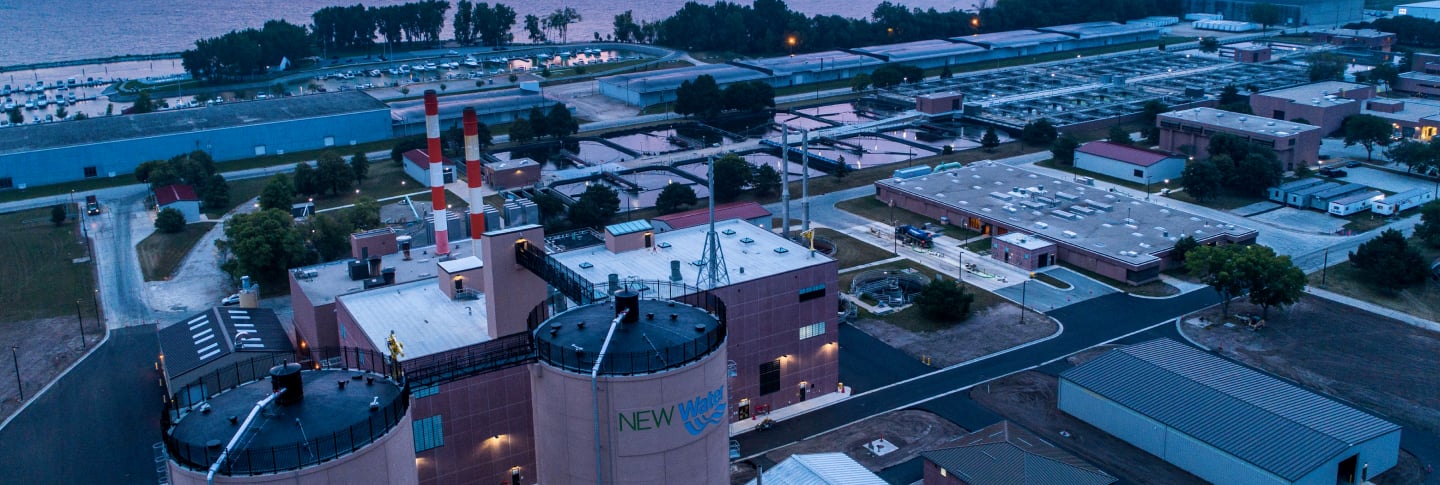


With the severe wet weather conditions in NEW Water's service area, our community's shared sanitary sewer system has been inundated with stormwater. Check out the media coverage below.
Learn more about Inflow & Infiltration (I&I) and how you can help >>
NEW Water sees over 5 times its normal flow as flooding overwhelms sewer, sanitary systems
By Tony Langfellow | April 2026 | Fox 11
The Green Bay area is continuing to deal with flooding after back-to-back storms this week.
Streets quickly became inundated with water and slowly drained Tuesday night. It was no different at the corner of Webster Avenue and Klaus Street -- a road reconstructed in recent years. This has some Facebook users questioning the effectiveness of the city's storm sewer system.
Green Bay Public Works Director Valerie Joosten said everything is working properly, but the shear amount of rain that has fallen simply backs everything up.
"When you have a big event like what we're experiencing, you may not necessarily be able to have everything drain immediately. It sometimes takes time for everything to work its way through the system," Joosten said.
Much of Webster Avenue was reconstructed in recent years, including the storm drainage system. It has large sewers underground and a swale was added to the median to help improve flood issues. Joosten said the age of the roads doesn't necessarily matter in this case, but with this much rain, patience is important as pump stations work nonstop.
"We're certainly experiencing a lot of water. The ground is wet. We just had our snow melt. So, it's just a combination of many things," Joosten said.
NEW Water, the brand of the Green Bay Metropolitan Sewerage District, has received more than five times the amount of water than it typically works with. This is because so much storm water has been entering the sanitary sewers -- not only through the ground, but from homes, too.
"We're certainly experiencing a lot of water. The ground is wet. We just had our snow melt. So, it's just a combination of many things," Joosten said.
NEW Water, the brand of the Green Bay Metropolitan Sewerage District, has received more than five times the amount of water than it typically works with. This is because so much storm water has been entering the sanitary sewers -- not only through the ground, but from homes, too.
"Some people may have their sump pump going to a mop sink or to a floor drain, and that then gets to the sanitary sewer system and puts a burden on that sanitary sewer system," NEW Water Executive Director Nathan Qualls said.
Qualls said NEW Water's treatment plant is not designed for that amount of water, putting a strain on its system. He said instead, folks should discharge sump pump water to the ground or down an outdoor storm drain. Otherwise, the sanitary sewer system could create problems inside your home.
"Their basement may back up because that sanitary sewer has just too much flow entering it," Qualls said.
NEW Water plans to keep monitoring the wastewater process closely as more rain comes through the area. Green Bay Public Works reminds residents to help keep storm drains clear of debris to prevent flooding.
April becomes wettest one ever in Green Bay. Here's what to know
By Benita Mathew & Jesse Lin | April 2026 | Green Bay Press Gazette
It's official — it's the wettest April ever in Green Bay, and there's still half of the month left.
As of April 15, Green Bay got 7.88 inches of precipitation, according to the National Weather Service Green Bay. It beat the record set in 1929 of 6.46 inches in the entire month of April.
That includes over 4 inches of rain April 13-15 that brought significant flooding and closed some area schools for a day. Some rain is still on the way tonight, but it will be more scattered throughout, said Jillian Goodin, a meteorologist with the National Weather Service Green Bay.
Starting in the evening April 15, the Green Bay area could get another 0.25 to 0.5 inch of rain through the night. Then there's a break in the weather until the afternoon of April 17 with more heavy rain.
In total, Green Bay got 14.5 inches so far this year, according to NWS data. By the same time last year, Green Bay saw 5.83 inches of rain.
Several roads closed to manage water levels and trails along the East River are still closed. On April 15, Brown County said that Pamperin Park in Howard was closed until further notice. Part of Riverside Drive needs to be repaired between Rock Bottom Court and St Pats Drive after it got washed out with the rain. The flood warning in Brown County is in effect until 1:30 p.m.
Some health clinics extended closings to April 15 because of ongoing flooding. Emplify Health's Riverside Behavioral Health clinic and Prevea East De Pere Health Center closed April 15 and will reopen April 16.
Water starts receding
Water levels have crested and are holding steady at Duck Creek and the East River.
Following a burst of rain the evening of April 14, water in the East River hit 12.08 feet at 9:25 p.m, or about four feet higher than the river’s typical eight-foot water level. About an hour later, at 10:45 p.m, Duck Creek in Howard peaked at about 19.64 feet, about a half foot shy from crossing over the creek’s threshold for moderate flooding at 20 feet.
Geoff Farr, public works director of Howard, said the night of April 14 that he didn’t expect water to rise much more at Duck Creek. The creek’s basin is influenced by rain in the county’s southwest, toward Freedom, which was less severe than around Green Bay, “so we are not preparing for or anticipating higher water,” Farr said. He added that water in the village was receding in most areas.
Water has come down slightly at both waterways through the morning of April 15, dropping about a foot by 9 a.m. to 11.21 feet at the East River and 18.97 feet at Duck Creek.
Water has started to drain from some of the most severely impacted parts of Allouez, Bellevue, Green Bay and Ledgeview along the East River.
As of 9:30 a.m., the intersection of Hoffman Road and East River Drive in Allouez was dry, though barricades and a sign of “Water Over Road” at Hoffman Road and Bellevue Street remained.
Ponds still saturate Ledgeview Park.
Water has stagnated over a portion of the East River Trail at Van Beaver Park in Green Bay.
Allouez offers special bulk pickup for flooding
A special bulk pickup option will be available for Allouez residents living in the part of the village most affected by flooding.
The village announced it will pick up bulk waste on April 22 from homes north of State 172, east of Libal Street, and south of East St. Joseph Street. This portion of the village, along the East River, has been especially affected by water flooding basements.
Bulk waste includes most household items, like mattresses, furniture, carpeting, windows, doors, wood, and sinks.
The village excluded cardboard, tires, gas or charcoal grills, other gas-powered equipment, exercise equipment, car batteries, light bulbs, electronics and home appliances.
Hobart declares state of emergency
Hobart Village Board President Rich Heidel on April 15 declared a state of emergency to accommodate the village's flood response.
The declaration, effective immediately and in effect "until further notice," cited heavy rains that led to flooding and damaged roads in the village. It requires those driving in the village to obey all posted barricades and signs that restrict or deny access to roads for the sake of cleaning storm damage.
Excess water pushes sewer system to its limits
The Green Bay Metropolitan Sewerage District, branded as NEW Water, saw about 214 million gallons of water in its system the morning of April 14, pushing the sewerage authority to its limits to try and pump over five times the amount of water it normally treats.
"This has been a challenging couple of days − unprecedented," Nathan Qualls, executive director of NEW Water told the Press-Gazette.
Water in the authority's sewer system, serving about 239,000 people across 15 communities in Brown County, ends up in either of its two treatment plants, in De Pere and Green Bay. On a normal day, the two plants process a combined 41 million gallons of wastewater, the authority said in an April 14 announcement.

When storms are strong, long, or come on top of already saturated ground, the sewer system can see between three and five times that typical amount of water. The storm water, which is supposed to enter storm sewers, ends up in the sanitary sewer system due to gaps in aging infrastructure or private homes attaching pumps to the sanitary sewer infrastructure.
The sewer infrastructure, taking on water not intended for processing by treatment plants, was not designed to handle over 200 million gallons of water on a regular basis and was pushed to its limits, Qualls said.
All pumps were online to handle the peak water levels the morning of April 14, according to Qualls. With the help of Brown County Emergency Management, De Pere, and Ledgeview, NEW Water crews tried to protect an electrical station along the East River from flooding, Qualls said.
In every NEW Water community, sewer levels ran high, Qualls said, a situation that can cause backups within pipes and localized flooding. In Allouez, the village announced on April 14 that its sanitary sewer system was "overwhelmed," causing flooded basements.
Water levels have since come down "significantly" since their peak, according to Qualls, for whom the event "highlights just how critical it is to invest in our infrastructure."