

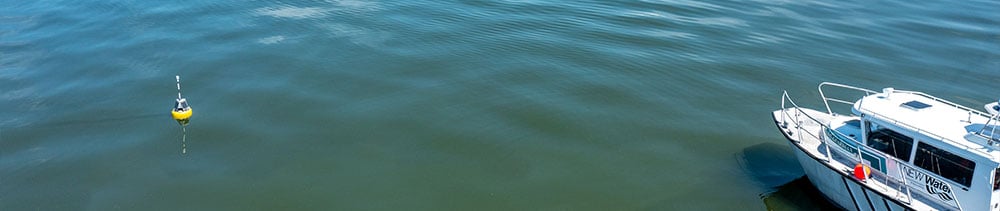


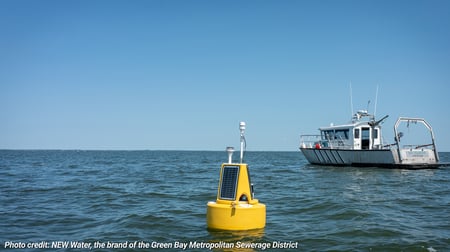
 Through a Great Lakes Observing System (GLOS) grant, NEW Water was able to deploy three buoys in Lower Green Bay (two new and one upgraded), each equipped with wave and weather monitoring.
The Green Bay Press Gazette story is found below. To see the story on Green Bay Press Gazette, please visit: New wave monitoring buoys aim to boost safety on Green Bay | www.greenbaypressgazette.com
New wave monitoring buoys aim to boost safety on Green Bay
By Kathryn Byrnes | August 2026 | Green Bay Press Gazette
Anyone with experience on the water is likely aware of how quickly weather can shift. Knowing the conditions on the the bay, for example, is critical for safety.
To help boaters and emergency responders track changing conditions on lower Green Bay, NEW Water deployed two new wave-monitoring buoys July 23.
A $74,430 grant from Great Lakes Observing System funded two new wave-monitoring buoys and allowed NEW Water, the brand of the Green Bay Metropolitan Sewerage District, to upgrade an existing buoy in lower Green Bay. Each buoy measures wave and weather conditions.
Prior to the buoys' placement, there was only one wave-monitoring buoy, located halfway between the cities of Green Bay and Sturgeon Bay − the two are about 40 miles apart on the bay.
"Which is pretty far, because conditions can ramp up, especially with the right wind conditions," said Shelby Brunner, a science and observations manager at the Great Lakes Observing System.
Wave and water level information in lower Green Bay has long been a "huge gap" for users such as the National Weather Service, recreational anglers and vessels in a major shipping lane, Brunner said.
NEW Water was one of five organizations selected by the Great Lakes Observing System for more monitoring systems.
Part of the grant allowed NEW Water to trade in old equipment for newer models.
"Get kind of the latest and greatest,” said Sarah Bartlett, a water resource specialist with NEW Water.
Bartlett said NEW Water pursued the project because of the need for more real-time information in the lower bay. “It is available in pretty much real time, which is a huge benefit to people who are going to be recreating,” she said.
NEW Water, which collects weekly water samples from lower Green Bay, will use the buoy data to track changing conditions and support its wastewater treatment, Bartlett said.
Having more data from lower Green Bay opens the door for more information to be gathered on water quality trends.
The buoys are a part of NEW Water's aquatic monitoring program, which has been around since 1986. Each buoy is five miles apart from the mouth of the Fox River going out into the bay.
 The buoys also help the Green Bay Metro Fire Department.
"Wave monitoring in lower Green Bay was a need," said Lt. Shauna Walesh of the fire department.
The real-time information helps the fire department assess conditions before and during water rescues on the bay, Walesh said.
"Weather conditions and just the atmosphere out there can change on a dime," she said.
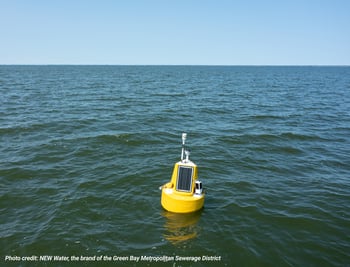
Each buoy records weather conditions, wind speed and direction, wave direction and height.
Bartlett said NEW Water hopes this data will allow boaters to operate more comfortability. "Getting information into the hands of the public is the most important thing that we can do," she said.
Data from the buoys is available through the Great Lakes Observing System's Seagull website. It is also posted on the NEW Water website.
Down the line, Brunner said they think this data will be valuable for people beyond the Green Bay area.
"There's a lot of work being done to improve the lake modeling capabilities and observation data is critical for calibrating that model,” Brunner said.
The goal is for the buoys to be in the bay from April through October, weather permitting.
Learn more about this project here >>
Check out water quality data directly on the GLOS Seagull Platform here >>